
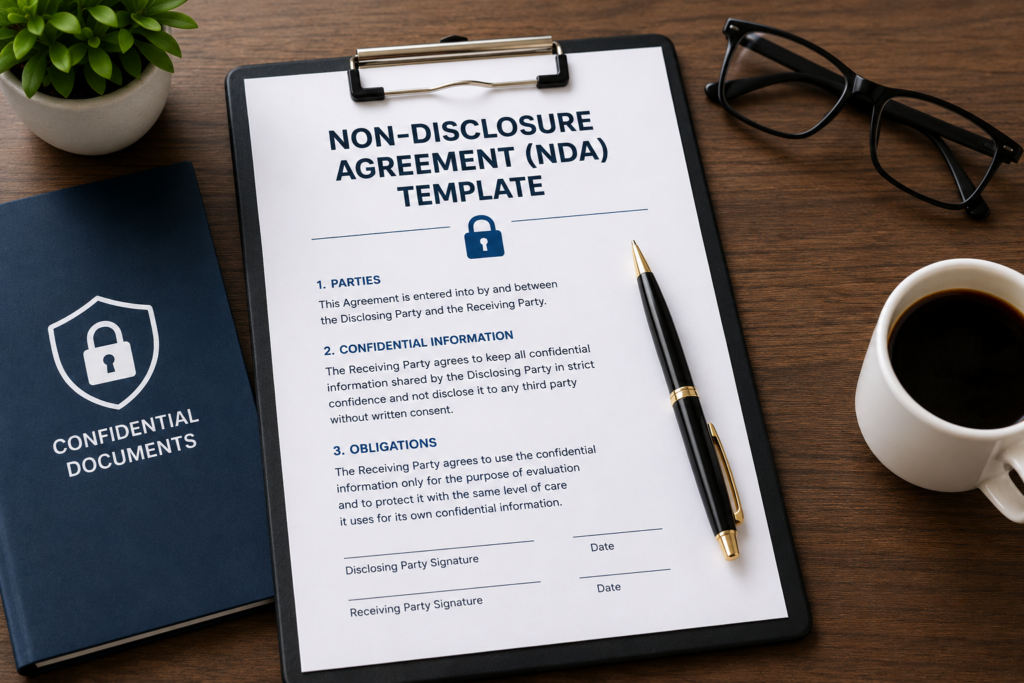
Non-Disclosure Agreement (NDA) Template (2026): Free Example
Last Updated: July 2026
This Non-Disclosure Agreement (NDA) Template gives businesses, freelancers and contractors a practical starting point for defining confidential information, permitted use, exclusions, duration and signatures. Because enforceability varies by jurisdiction and circumstance, treat the template as informational and obtain legal advice for important agreements.
Table of Contents
Featured Snippet Answer
A Non-Disclosure Agreement (NDA) Template is a legal document used to protect confidential information shared between two or more parties. It defines what information is private, how it may be used, how long it must remain confidential, and what happens if the agreement is broken.
What Is a Non-Disclosure Agreement?
A Non-Disclosure Agreement, often called an NDA, is a written contract that helps protect sensitive information. Businesses use NDAs when they share private details with employees, contractors, investors, partners, suppliers, or potential buyers.
The main goal is simple: the person receiving confidential information agrees not to disclose it or misuse it. This can include business plans, software code, marketing strategies, financial records, client lists, formulas, designs, processes, and trade secrets.
A well-written NDA creates trust before important conversations begin. It also gives the disclosing party a legal path if confidential information is shared without permission.
Why Use a Non-Disclosure Agreement (NDA) Template?
Using a Non-Disclosure Agreement (NDA) Template saves time and helps you avoid missing important sections. Instead of starting from scratch, you begin with a structured format that covers the most common legal and business points.
An NDA is especially useful before discussing new products, business ideas, partnerships, freelance work, mergers, acquisitions, app development, agency work, or consulting projects.
Main Benefits
- Protects confidential business information.
- Sets clear rules for private data.
- Reduces misunderstandings between parties.
- Supports professional and secure collaboration.
- Helps protect intellectual property and trade secrets.
Key Clauses Included in an NDA Template
1. Parties to the Agreement
This section identifies the disclosing party and the receiving party. In a mutual NDA, both parties may share confidential information.
2. Definition of Confidential Information
This clause explains what information is protected. It should be clear, specific, and broad enough to cover written, oral, digital, technical, financial, and commercial information.
3. Exclusions from Confidential Information
Not all information can be protected. Common exclusions include information already public, already known by the receiving party, independently developed, or legally required to be disclosed.
4. Obligations of the Receiving Party
The receiving party usually agrees to keep the information private, use it only for the agreed purpose, limit access, and protect it with reasonable care.
5. Duration of Confidentiality
This section states how long the NDA remains active. Some NDAs last two to five years, while trade secret protection may continue as long as the information remains confidential.
6. Return or Destruction of Materials
When the relationship ends, the receiving party may need to return or destroy confidential documents, files, samples, or records.
7. Remedies and Enforcement
This clause explains what may happen if the NDA is breached. Remedies can include damages, injunctions, or other legal action.
8. Governing Law
This section states which country, state, or jurisdiction governs the agreement.
Free NDA Template Structure
Non-Disclosure Agreement Template
This Non-Disclosure Agreement is entered into on [Date] by and between [Disclosing Party Name], located at [Address], and [Receiving Party Name], located at [Address].
1. Purpose
The parties wish to discuss a potential business relationship involving confidential information.
2. Confidential Information
Confidential Information includes all non-public business, financial, technical, operational, marketing, customer, product, and strategic information disclosed by one party to the other.
3. Obligations
The Receiving Party agrees to keep the Confidential Information private, use it only for the stated purpose, and not disclose it to third parties without written consent.
4. Exclusions
Confidential Information does not include information that is public, already known, independently developed, or legally required to be disclosed.
5. Term
This Agreement remains effective for [Number] years from the date of signature, unless otherwise required by law.
6. Return of Materials
Upon request, the Receiving Party shall return or destroy all Confidential Information.
7. No License
Nothing in this Agreement grants ownership or license rights to the Receiving Party.
8. Governing Law
This Agreement shall be governed by the laws of [Jurisdiction].
9. Signatures
Disclosing Party: __________________ Date: ________
Receiving Party: __________________ Date: ________
Best Practices Before Signing an NDA
- Use clear and simple language.
- Define confidential information carefully.
- Choose the right type: unilateral, mutual, employee, contractor, or investor NDA.
- Set a realistic confidentiality period.
- Review governing law and enforcement terms.
- Get legal advice for high-value or complex transactions.
EEAT: Why This NDA Guide Is Trustworthy
This guide is written for business owners, freelancers, agencies, startups, and professionals who need a practical understanding of confidentiality agreements. It focuses on clear contract structure, common business use cases, and responsible risk reduction.
Important: This article is for informational purposes only and is not legal advice. For complex matters, consult a qualified legal professional. For a neutral legal definition and overview, see Cornell Law School’s NDA overview, which explains that NDAs are contract-law agreements used to keep specified information confidential.
Helpful Related Templates
NDA Review Checklist
- The parties and purpose are identified correctly.
- Confidential information and exclusions are defined clearly.
- Permitted use, access, storage, and disclosure rules are stated.
- Required disclosures and notice procedures are addressed.
- Return, deletion, retention, and backup obligations are realistic.
- The term and trade-secret treatment match the applicable law.
- Governing law, remedies, signatures, and authority are reviewed.
Frequently Asked Questions
What is a Non-Disclosure Agreement?
It is a contract that protects confidential information shared between parties.
Do I need an NDA before sharing a business idea?
It depends on the information, relationship, bargaining position, and purpose of the discussion. An NDA can help protect genuinely confidential information, but it does not automatically protect every idea or replace other intellectual-property and trade-secret measures.
Can an NDA protect trade secrets?
Yes, an NDA can help protect trade secrets if the information remains confidential and is handled properly.
Is a mutual NDA different from a one-way NDA?
Yes. A one-way NDA protects information from one party, while a mutual NDA protects information shared by both parties.
How long should an NDA last?
Many NDAs last between two and five years, but trade secret obligations may last longer.
Should a lawyer review my NDA?
Yes, especially for high-value deals, employment matters, investment talks, or complex intellectual property issues.
Ready to Protect Your Confidential Information?
Use this NDA structure as a starting point, customize it for your business, and review it carefully before signing. For important legal matters, speak with a qualified attorney.
Get Help Customizing Your NDA