
Cold Email Templates: How to Write Emails That Get Replies (2026)
Last Updated: May 2026
Sending a business outreach email to a stranger can feel like shouting into a void. Most cold emails are ignored because they sound generic, sales-heavy, or too focused on the sender instead of the recipient.
But strong cold email templates can help you write faster, sound more professional, and improve your chances of getting a reply. In 2026, successful cold outreach depends on personalization, short messaging, clear value, and a low-friction call to action.
How Do You Write a Cold Email That Gets Replies?
A successful cold email should include a personalized opening, a clear value proposition, proof or context, and a low-friction call to action. Most high-performing cold emails stay under 120 words and focus on the recipient’s problem rather than the sender’s product.
Write Better Cold Emails Faster
Use our AI Professional Email Writer to create polished outreach emails, follow-ups, business messages, and client communication in seconds.
Try the AI Email Writer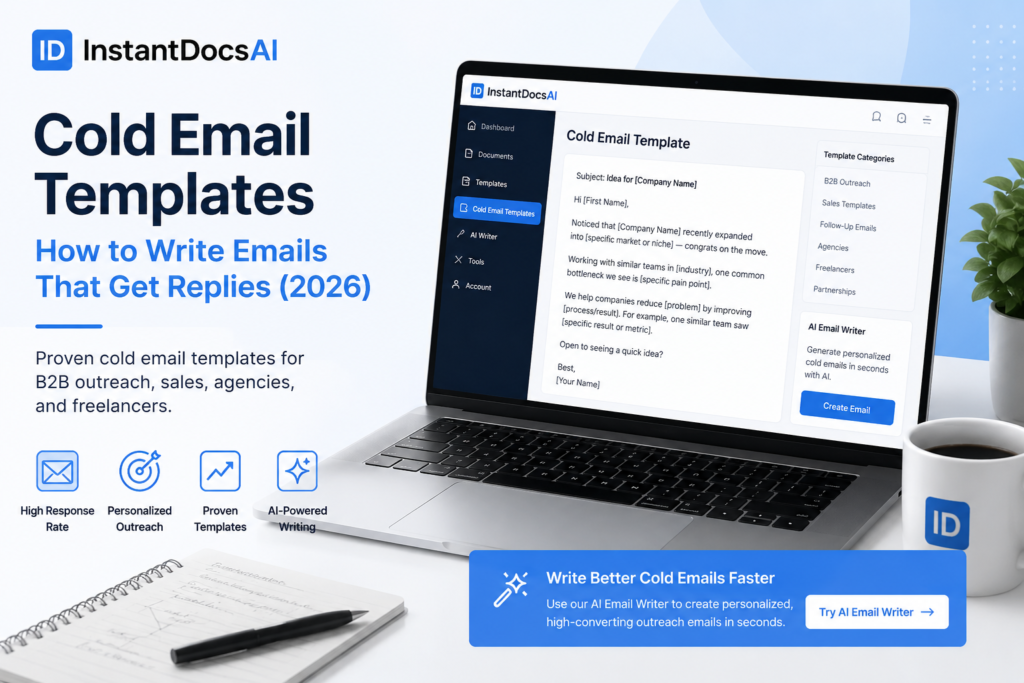
What Is a Cold Email?
A cold email is a professional outreach message sent to someone who has not previously contacted you. It is often used in B2B sales, partnerships, consulting, recruiting, freelancing, agency outreach, and business development.
A good cold email should not feel like spam. It should be short, relevant, personalized, and focused on starting a conversation. The goal is not to close a deal immediately. The goal is to earn a reply.
Why Most Cold Business Outreach Emails Fail
Most cold emails fail because they are too long, too generic, or too focused on the sender. Busy professionals do not have time to decode unclear messages from people they do not know.
- They focus too much on the sender: The email talks about your company, product, or services instead of the recipient’s problem.
- They are too long: A 400-word cold email from a stranger rarely gets read.
- They use fake urgency: Subject lines like “Urgent” or “Re:” can destroy trust quickly.
- They have unclear CTAs: Asking for a 30-minute meeting too early creates friction.
- They lack personalization: Generic emails feel automated and easy to ignore.
The 4-Part Anatomy of a High-Converting Cold Email
1. Subject Line
Your subject line should be short, natural, and relevant. It should feel like a real message, not a marketing campaign.
2. Personalized Opening
Show that you know who the recipient is. Mention a company update, recent post, hiring trend, podcast appearance, website detail, or relevant business change.
3. Value Proposition
Explain the outcome you can help create. Avoid listing features. Focus on business value, time saved, cost reduced, revenue improved, or friction removed.
4. Low-Friction CTA
Do not ask for too much too soon. Instead of requesting a long meeting, ask a simple question such as “Open to seeing a quick idea?” or “Worth a brief exchange?”
Best Cold Email Subject Lines (2026)
- quick question
- idea for [company]
- noticed something
- question about [department]
- thoughts on this?
- worth a look?
- small idea for [company]
- helping companies like yours
- quick win for your team
- noticed your recent growth