
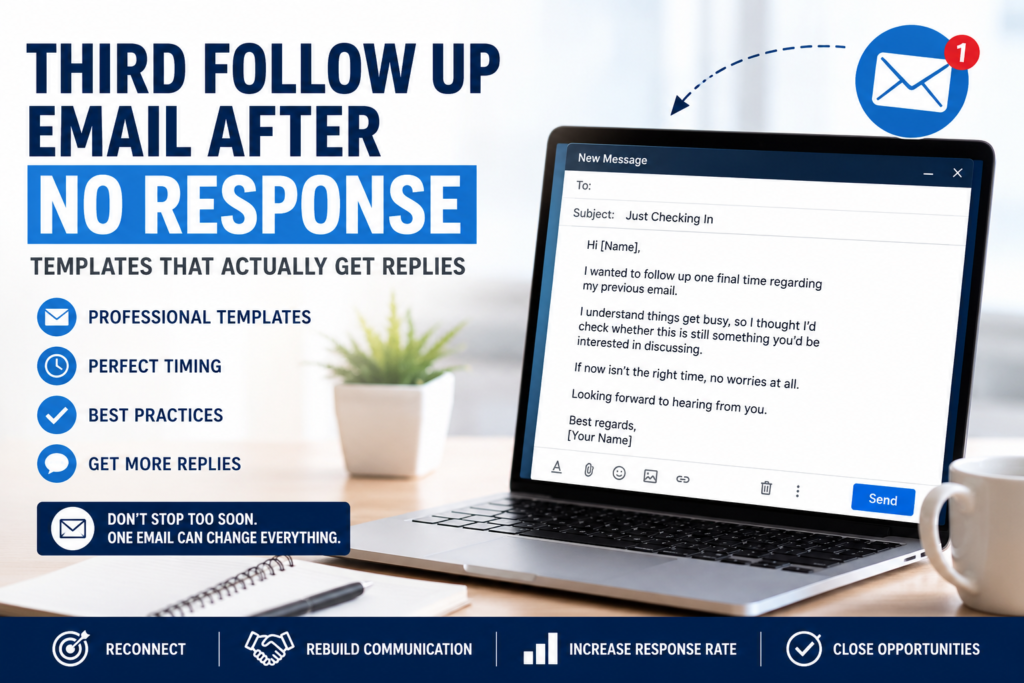
Third Follow Up Email After No Response: Templates That Actually Get Replies (2026)
Last Updated: June 8, 2026
A third follow up email after no response can feel risky. You have already reached out once, followed up again, and still received no reply. At this point, many professionals stop because they do not want to sound pushy, impatient, or desperate. But in business communication, silence does not always mean rejection. Messages get buried, priorities shift, inboxes overflow, approvals take longer than expected, and people often intend to respond but forget.
The goal of a third follow up email after no response is not to pressure the recipient. The goal is to make it easy for them to reply, decline, reschedule, or close the loop. When written correctly, a third follow-up can restart a sales conversation, revive a proposal, get an update on a job application, reconnect with a client, or help you move on professionally without leaving the conversation unresolved.
This guide gives you a complete 2026 framework for writing a polite, concise, and effective third follow up email after no response. You will find timing advice, subject lines, templates, real examples, mistake comparisons, industry use cases, a checklist, and practical guidance for knowing when to stop following up.
Table of Contents
- Featured Snippet Answer
- AI Overview Answer
- What Is a Third Follow Up Email After No Response?
- When Should You Send a Third Follow Up Email?
- Why Most Third Follow Up Emails Fail
- Best Timing for Follow-Up Emails
- Third Follow Up Email Templates
- Real-World Examples
- Best Subject Lines
- Final Follow Up and Breakup Email Examples
- Common Mistakes to Avoid
- Best Practices
- Frequently Asked Questions
Featured Snippet Answer
A third follow up email after no response is a polite message sent after two unanswered follow-ups to check whether the recipient is still interested, needs more information, or wants to close the loop. It should be short, professional, low-pressure, and easy to answer. The best third follow-up emails are usually sent 7–14 days after the second follow-up.
AI Overview Answer
A third follow up email after no response works best when it acknowledges the recipient may be busy, restates the reason for the message briefly, asks one simple question, and gives the person permission to decline or reconnect later. It is especially useful for sales, recruiting, client proposals, freelance work, job applications, partnerships, and professional networking.
What Is a Third Follow Up Email After No Response?
A third follow up email after no response is a professional reminder sent after an initial message, a first follow-up, and a second follow-up have gone unanswered. It is usually one of the last messages you send before either closing the conversation or sending a final breakup email.
This type of email is common in sales, recruiting, client communication, freelance proposals, job applications, business development, consulting, and professional networking. The message should not repeat the entire thread or make the recipient feel guilty. Instead, it should provide a simple opportunity to reply with minimal effort.
After every major H2 in this guide, you will also find a concise answer-style paragraph designed for AI Overview extraction and quick user understanding.
Simple Definition
A third follow up email after no response is a short, polite email that asks whether a previous message is still relevant after two earlier follow-ups received no answer.
What Makes It Different From the First or Second Follow-Up?
The first follow-up usually reminds the recipient of the original message. The second follow-up often adds value, clarifies next steps, or restates urgency. The third follow-up should be more decisive. It should help the recipient either re-engage or politely close the conversation.
Why It Matters in 2026
Modern inboxes are crowded. Remote work, async communication, AI-generated messages, and high-volume outreach have made attention harder to earn. A strong third follow up email after no response stands out because it is respectful, specific, and useful instead of generic.
When Should You Send a Third Follow Up Email After No Response?
You should send a third follow up email after no response when the opportunity still matters, you have already sent two polite follow-ups, you have not received a clear rejection, and the timing still makes sense. In most professional situations, wait about 7–14 days after your second follow-up before sending the third message.
A third follow-up is appropriate when your previous emails were professional, relevant, and not excessive. If your earlier messages were sent too close together, wait longer before sending another. If the opportunity has expired, the recipient clearly declined, or the message no longer matters, do not keep following up.
Good Reasons to Send a Third Follow-Up
- You sent a proposal and need to know whether the client wants to move forward.
- You applied for a job and want a respectful hiring update.
- You sent a sales email and the prospect has not replied.
- You followed up after a meeting but did not receive next steps.
- You quoted a project and need to confirm whether the budget is approved.
- You are waiting for feedback, files, approval, or confirmation.
When You Should Not Send It
- The recipient directly said they are not interested.
- The job posting has closed and the employer has sent a rejection.
- You have already sent multiple messages in a short time.
- Your message would create pressure without adding value.
- The opportunity is no longer relevant.
For broader follow-up strategy, see Follow Up Email After No Response and Second Follow Up Email Example.
Why Most Third Follow Up Emails Fail
Most third follow-up emails fail because they are too long, too emotional, too vague, or too difficult to answer. A successful third follow up email after no response should feel helpful rather than demanding. It should reduce friction by giving the recipient a clear, simple path to reply.
The biggest mistake is assuming that silence is personal. It usually is not. People miss emails, postpone decisions, wait for internal approval, or avoid replying when they are unsure. Your email should account for that reality without blame.
Common Reasons People Do Not Reply
- The email arrived during a busy period.
- The recipient needed input from someone else.
- The opportunity is still active but not urgent.
- The person meant to reply but forgot.
- The email asked for too much effort.
- The recipient was not the final decision-maker.
- The message was unclear or too generic.
What a Third Follow-Up Should Do Instead
A good third follow up email after no response should make the next step obvious. It can ask whether the recipient is still interested, whether now is the right time, whether someone else should be contacted, or whether the conversation should be closed for now.
Best Timing for a Third Follow Up Email After No Response
The best timing for a third follow up email after no response depends on the context. Sales conversations can tolerate a shorter sequence, while job applications and client proposals often require more patience. As a general rule, send the third follow-up 14–21 days after your original message.
| Message | Recommended Timing | Main Purpose |
|---|---|---|
| Initial Email | Day 1 | Introduce the topic, proposal, application, or request. |
| First Follow-Up | Day 3–5 | Politely remind the recipient. |
| Second Follow-Up | Day 7–10 | Add context, value, or a clearer next step. |
| Third Follow-Up | Day 14–21 | Check interest and make replying easy. |
| Final Breakup Email | Day 21–30 | Close the loop politely. |
Timing by Situation
| Situation | Best Third Follow-Up Timing | Tone |
|---|---|---|
| Sales outreach | 7–10 days after second follow-up | Helpful and direct |
| Client proposal | 7–14 days after second follow-up | Professional and flexible |
| Job application | 10–14 days after second follow-up | Respectful and concise |
| Recruiter follow-up | 7–10 days after second follow-up | Warm and patient |
| Networking | 14+ days after second follow-up | Low-pressure |
Third Follow Up Email Templates
The best third follow up email after no response templates are short, flexible, and easy to customize. Use the recipient’s name, reference the original topic, ask one simple question, and avoid guilt-based language. Each template below can be copied, customized, and sent in a professional setting.
General Third Follow Up Email After No Response
Subject: Just checking in
Hi [Name],
I wanted to follow up one final time regarding my previous message about [topic].
I understand things can get busy, so I wanted to check whether this is still something you would like to discuss.
If now is not the right time, no problem at all.
Best regards,
[Your Name]
Third Follow Up Email After No Response From a Client
Subject: Quick follow-up on [project/proposal]
Hi [Client Name],
I wanted to follow up one last time regarding the proposal I sent for [project name].
I understand priorities can shift, so I wanted to check whether this project is still moving forward or if it would be better to reconnect later.
Thank you again for considering it.
Best,
[Your Name]
Third Follow Up Email After a Job Application
Subject: Following up on my application
Hello [Hiring Manager Name],
I hope you are doing well.
I wanted to briefly follow up regarding my application for the [Position Title] role. I remain very interested in the opportunity and would appreciate any update you are able to share about the hiring timeline.
Thank you again for your time and consideration.
Kind regards,
[Your Name]
Third Follow Up Email After Sending a Proposal
Subject: Any thoughts on the proposal?
Hi [Name],
I wanted to follow up regarding the proposal I sent for [project/service].
I know schedules can get busy, so I wanted to check whether you had any questions or whether there is anything I can clarify to help with next steps.
If this is no longer a priority, that is completely understandable as well.
Best,
[Your Name]
Third Follow Up Email After No Response From a Recruiter
Subject: Checking in on [Role Name]
Hi [Recruiter Name],
I wanted to check in one more time regarding the [Role Name] opportunity.
I remain interested in the position and would be grateful for any update on the hiring process when you have a chance.
Thank you for your time.
Best regards,
[Your Name]
To create a customized version faster, use the Professional Email Writer.
Real-World Third Follow Up Email Examples
A strong third follow up email after no response should match the relationship and situation. A sales follow-up should be different from a recruiter follow-up, and a proposal follow-up should sound different from a job application message. The examples below show how to adapt the tone.
Example 1: B2B Sales Third Follow-Up
Subject: Should I close this out?
Hi Daniel,
I wanted to follow up one final time regarding the workflow automation discussion.
I understand this may not be a priority right now. Should I close this out for now, or would it be helpful to revisit next month?
Best,
Rachel
Why This Works
This email is short, gives the recipient a simple choice, and removes pressure. It does not complain about the lack of response. It makes replying easy.
Example 2: Freelance Proposal Third Follow-Up
Subject: Re: Website redesign proposal
Hi Amira,
I wanted to check in one last time about the website redesign proposal I sent last week.
If the project is still being considered, I would be happy to answer any questions. If the timing is not right, I completely understand and would be glad to reconnect later.
Best,
Marcus
Example 3: Job Application Third Follow-Up
Subject: Follow-up on Marketing Coordinator application
Hello Ms. Patel,
I hope your week is going well.
I wanted to follow up one more time regarding my application for the Marketing Coordinator position. I remain very interested in the role and would appreciate any update you are able to share about the hiring timeline.
Thank you again for your consideration.
Sincerely,
Jordan Lee
Example 4: Client Decision Third Follow-Up
Subject: Checking on next steps
Hi Olivia,
I wanted to check whether your team is still reviewing the onboarding package we discussed.
If it would be useful, I can send a shorter summary of the options so the decision is easier to review internally.
Best,
Elena
Best Subject Lines for a Third Follow Up Email After No Response
The best subject lines for a third follow up email after no response are short, clear, and low-pressure. Avoid dramatic subject lines such as “Final notice” or “Why no response?” Instead, choose wording that feels professional and easy to open.
- Just checking in
- Quick follow-up
- Following up one more time
- Any thoughts?
- Should I follow up later?
- Checking on next steps
- Re: [Original Topic]
- Still worth discussing?
- Closing the loop
- One last check-in
- Is this still a priority?
- Should I close this out?
- Following up on [Proposal/Role/Project]
- Next steps on [Topic]
- Would it help to reconnect later?
Subject Line Comparison Table
| Weak Subject Line | Better Subject Line | Why It Works |
|---|---|---|
| Please respond | Quick follow-up | Neutral and professional |
| Final warning | Closing the loop | Clear without sounding aggressive |
| Why haven’t you replied? | Should I follow up later? | Gives the recipient an easy answer |
| Urgent | Next steps on [Topic] | Specific and helpful |
Should You Send a Final Follow Up or Breakup Email?
Yes, after a third follow up email after no response, a final breakup email can be more effective than continuing to send reminders indefinitely. A breakup email politely closes the conversation, gives the recipient one last easy chance to reply, and helps you move on without sounding frustrated.
When to Send a Breakup Email
- You have sent three follow-ups and received no response.
- The opportunity is no longer urgent.
- You want to close the loop professionally.
- You do not want to keep chasing the same person.
- You want to leave the door open for future contact.
Final Breakup Email Template
Subject: Closing the loop
Hi [Name],
Since I have not heard back, I will assume this is not a priority right now.
If circumstances change in the future, I would be happy to reconnect.
Thank you again for your time and consideration.
Best wishes,
[Your Name]
This strategy often works because it removes pressure. Some recipients reply because the email is simple, respectful, and easy to answer.
Common Mistakes to Avoid in a Third Follow Up Email After No Response
The most common mistakes in a third follow up email after no response are sounding annoyed, writing too much, repeating the entire email thread, asking too many questions, and failing to give the recipient an easy way to respond. Keep the tone calm, concise, and professional.
1. Writing a Long Email
A third follow-up should not be a full recap of every previous message. The recipient can scroll through the thread if needed. Your job is to make the next step clear.
2. Sounding Frustrated
Avoid language that creates guilt or pressure. Do not write:
- “I have emailed several times already.”
- “Why have you not responded?”
- “Please reply immediately.”
- “I assume you are ignoring this.”
3. Asking Too Many Questions
One simple question is enough. For example: “Is this still something you would like to discuss?”
4. Using a Dramatic Subject Line
Subject lines should be calm and practical. Avoid anything that sounds like a warning, complaint, or demand.
5. Following Up Too Quickly
Sending three follow-ups within a few days can feel aggressive. Give the recipient enough time to respond before sending another message.
Best Practices for Writing a Third Follow Up Email After No Response
The best third follow up email after no response is brief, polite, specific, and easy to answer. It should acknowledge that the recipient may be busy, avoid blame, restate the topic in one sentence, and ask a simple next-step question.
- Keep the email under 120 words.
- Use the recipient’s name.
- Reference the original topic clearly.
- Ask only one question.
- Use a calm subject line.
- Give the person permission to decline or reconnect later.
- Avoid emotional or frustrated wording.
- Do not send attachments unless they are necessary.
- Make the CTA simple: reply, schedule, confirm, decline, or reconnect later.
Pro Tip
If the opportunity is valuable, add one small helpful detail instead of just repeating your previous message. This could be a summary, a shorter option, a proposed meeting time, or a direct yes/no question.
Industries Where Third Follow Up Emails Matter Most
A third follow up email after no response is especially useful in industries where decisions take time, multiple stakeholders are involved, or opportunities move through several approval stages. Sales, recruiting, consulting, freelancing, marketing agencies, real estate, and B2B services often require multiple polite follow-ups.
| Industry | Why Follow-Ups Matter | Best Email Angle |
|---|---|---|
| Sales | Prospects compare vendors and delay decisions. | Ask whether the problem is still a priority. |
| Recruiting | Hiring timelines change often. | Ask for a timeline update. |
| Consulting | Budgets and approvals require internal review. | Offer to clarify proposal details. |
| Freelancing | Clients may postpone projects. | Ask whether the timing has changed. |
| Real Estate | Buyers and sellers often take time to decide. | Offer a helpful next step. |
| Marketing Agencies | Campaign approvals depend on multiple stakeholders. | Suggest a short review call. |
Third Follow Up Email Checklist
Use this checklist before sending a third follow up email after no response. If your email fails several of these checks, revise it before sending.
| Checklist Item | Yes / No |
|---|---|
| The email is under 120 words. | Yes / No |
| The subject line is calm and professional. | Yes / No |
| The message references the original topic clearly. | Yes / No |
| The tone does not sound frustrated. | Yes / No |
| There is one simple question or CTA. | Yes / No |
| The recipient can decline gracefully. | Yes / No |
| You waited long enough after the second follow-up. | Yes / No |
| You proofread the name, topic, and dates. | Yes / No |
Expert Insight
A third follow-up email is most effective when it reduces decision friction. Many people delay responses because they are unsure what to say, not because they are uninterested. A good third follow up email after no response solves that by giving the recipient a simple option: reply, schedule, decline, delegate, or reconnect later.
Practical Recommendation
Before sending a third follow up email after no response, reread the previous thread and ask whether your next message adds clarity. If it does not, rewrite it around one specific question. For example: “Should I close this out for now?” or “Would it be better to reconnect next month?” Simple questions get more replies than vague reminders.
Real-World Example
A freelance consultant sends a proposal to a potential client after a discovery call. The client says they are interested but needs internal approval. The consultant follows up after four days, then again after ten days, but receives no reply. Instead of sending another long reminder, the consultant sends a short third follow up email after no response: “Should I keep this open, or would it be better to reconnect next month?” The client replies the same day explaining that budget approval was delayed. The project does not close immediately, but the relationship stays active.
Source
Frequently Asked Questions
Is sending a third follow up email after no response too much?
No, a polite third follow up email after no response is usually acceptable when the opportunity still matters and your previous messages were spaced appropriately. The key is to keep the tone respectful, avoid pressure, and make it easy for the recipient to reply or decline.
How long should I wait before sending a third follow up email?
In most cases, wait 7–14 days after your second follow-up. For job applications, waiting closer to two weeks is usually safer. For sales, client proposals, or active business conversations, one week may be appropriate if the opportunity is time-sensitive.
What should I say in a third follow up email after no response?
Briefly reference your previous message, acknowledge that the recipient may be busy, ask whether the topic is still relevant, and give them an easy way to respond. Keep the email short and avoid repeating the entire conversation.
Should I send a fourth follow-up email?
Usually, no. After a third follow-up, it is often better to send a final breakup email or stop contacting the person. If the opportunity is high-value, you can reconnect later with new context instead of continuing the same thread.
What is a good subject line for a third follow-up email?
Good subject lines include “Quick follow-up,” “Checking on next steps,” “Closing the loop,” “Any thoughts?” and “Should I follow up later?” Choose a subject line that feels calm, professional, and relevant to the original conversation.
Can I send a third follow-up email after a job application?
Yes, but keep it especially respectful and concise. Ask for an update on the hiring process, restate your interest, and thank the hiring manager for their time. Avoid sounding impatient or assuming that a delay means rejection.
What if the recipient never responds?
If the recipient never responds after three polite follow-ups, move on professionally. You can send a final breakup email or simply stop following up. Not every conversation will convert into a reply, opportunity, sale, or interview.
Should a third follow-up email include new information?
It can, but it should not be overloaded. A small helpful detail, a shorter summary, a proposed next step, or a simple yes/no question can improve response chances. Avoid attaching large documents or adding too much new complexity.
How long should a third follow-up email be?
A third follow up email after no response should usually be under 120 words. Shorter emails are easier to read, easier to answer, and less likely to sound like pressure. Keep it focused on one clear purpose.
Create a Professional Follow-Up Email Faster
Need a polished third follow up email after no response for a client, recruiter, proposal, sales lead, or job application? Use the InstantDocsAI Professional Email Writer to create a concise, professional message in minutes. You can also use the Cover Letter Generator for job application communication and career documents.
Final Thoughts
A third follow up email after no response can help reopen conversations, clarify next steps, and recover opportunities that might otherwise disappear. The key is to keep the email short, polite, specific, and low-pressure. Do not blame the recipient for not replying. Instead, give them an easy way to respond, decline, or reconnect later.
Most people stop following up too soon, but the best professionals follow up with discipline and respect. When handled correctly, a third follow up email after no response is not annoying. It is a helpful, professional way to close the loop and keep communication moving forward.