
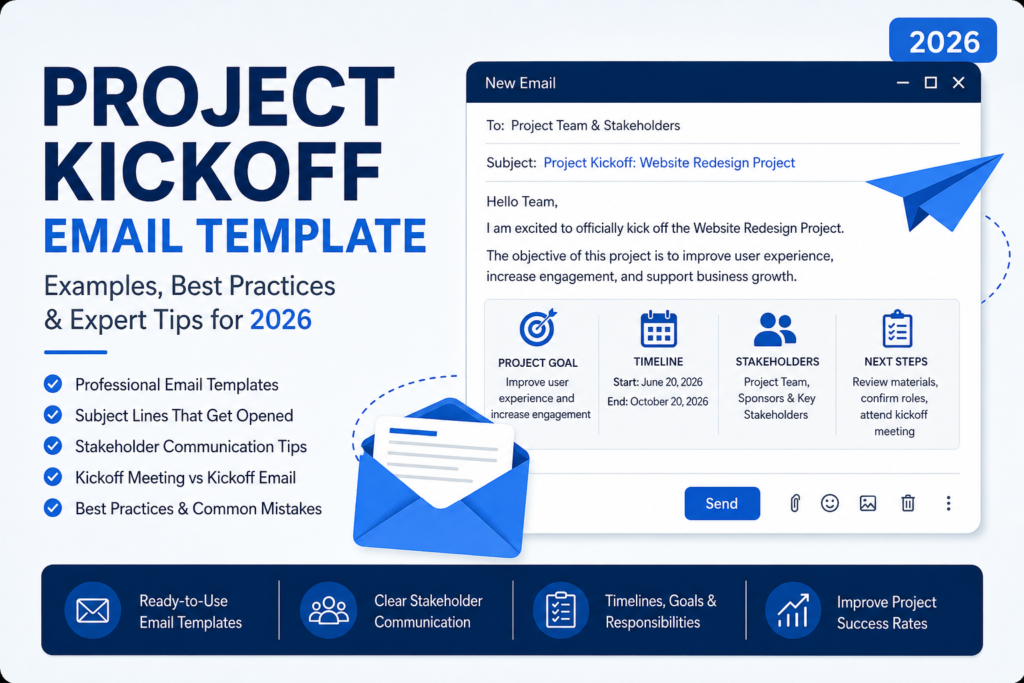
Project Kickoff Email Template (2026): Examples, Subject Lines & Best Practices
Last Updated: June 2026
A project kickoff email template is one of the most important business communication tools in project management. Before deadlines, milestones, status reports, and stakeholder updates begin, every successful project starts with a clear kickoff message that aligns expectations and sets the tone for collaboration.
Whether you’re launching an internal initiative, onboarding a new client, starting a software implementation, managing a construction project, or coordinating a cross-functional team, the kickoff email serves as the official starting point for execution.
Unfortunately, many professionals rush this step. They send vague emails that fail to establish ownership, communication expectations, timelines, or project goals. This creates confusion that often leads to delays, duplicated work, missed deadlines, and stakeholder frustration.
In this comprehensive guide, you’ll learn exactly how to write a professional project kickoff email, when to send it, what information to include, common mistakes to avoid, subject line examples, real-world templates, and proven best practices used by project managers and team leaders in 2026.
Featured Snippet Answer
A project kickoff email is a professional message sent at the beginning of a project to introduce team members, define objectives, outline timelines, establish communication expectations, and align stakeholders. Effective kickoff emails include project goals, key milestones, team responsibilities, meeting schedules, and next steps. They help reduce confusion, improve collaboration, and ensure everyone starts with the same understanding of project expectations.
AI Overview Answer
A project kickoff email template provides a structured format for launching projects successfully. It typically includes a project overview, objectives, scope, timeline, stakeholder introductions, communication guidelines, responsibilities, and immediate action items. Organizations use kickoff emails to create alignment before project execution begins, helping teams reduce misunderstandings and improve accountability throughout the project lifecycle.
Table of Contents
What Is a Project Kickoff Email?
A project kickoff email is the formal communication sent at the beginning of a project to all stakeholders, team members, clients, sponsors, or partners involved in the initiative.
Its primary purpose is to establish alignment before work begins.
Rather than assuming everyone understands the project’s goals, timeline, deliverables, and communication process, a kickoff email documents these expectations clearly from day one.
Think of it as the written counterpart to a project kickoff meeting. While meetings create discussion, kickoff emails create documentation and accountability. They give participants a reference point they can revisit throughout the project.
According to modern project management frameworks, successful project launches require early alignment around objectives, scope, timelines, ownership, communication methods, and risk awareness. A kickoff email helps establish that alignment before execution begins.
Project kickoff emails are commonly used in:
- Software development projects
- Marketing campaigns
- Construction projects
- Consulting engagements
- Client onboarding initiatives
- Corporate transformation programs
- Product launches
- Internal process improvement projects
Why Project Kickoff Emails Matter
Many project failures occur because expectations are never fully aligned at the start.
Stakeholders may have different interpretations of goals, responsibilities, deliverables, or timelines. Team members may assume someone else owns a critical task. Communication channels may never be defined.
A professional kickoff email reduces these risks by creating clarity before work begins.
Research and project management best practices consistently show that successful project launches depend heavily on stakeholder alignment, role clarity, communication standards, and documented expectations.
Benefits of sending a kickoff email include:
- Creates a shared understanding of project goals
- Clarifies team roles and responsibilities
- Reduces onboarding time for stakeholders
- Documents project scope and timelines
- Establishes communication protocols
- Minimizes confusion and misunderstandings
- Improves accountability
- Creates a professional first impression
- Supports remote and hybrid collaboration
- Provides a written reference throughout the project
For organizations managing multiple projects simultaneously, standardized kickoff emails help create consistency across teams and departments.
When Should You Send a Project Kickoff Email?
The ideal time to send a kickoff email is immediately after project approval and before major execution activities begin.
Typically, kickoff emails are sent:
- After project approval
- Before the kickoff meeting
- Immediately after the kickoff meeting
- Before assigning major tasks
- At the start of a new project phase
- When onboarding new stakeholders
- Before launching client engagements
Many project managers send two kickoff communications:
- Pre-kickoff email (meeting invitation and agenda)
- Post-kickoff email (summary, decisions, action items)
This approach ensures that stakeholders remain aligned before and after the formal kickoff discussion. Documentation of goals, scope, ownership, and action items is considered a critical project management practice.
Good vs Bad Project Kickoff Emails
| Element | Effective Kickoff Email | Poor Kickoff Email |
|---|---|---|
| Objectives | Clearly defined | Not mentioned |
| Timeline | Specific milestones | Vague deadlines |
| Ownership | Responsibilities assigned | No accountability |
| Communication | Defined channels | Unclear process |
| Action Items | Documented | Missing |
| Professionalism | Structured and organized | Informal and incomplete |
Essential Components of a Project Kickoff Email
A strong project kickoff email should include the following elements:
- Project name
- Project purpose and goals
- Key stakeholders
- Team member introductions
- Timeline and milestones
- Deliverables
- Communication expectations
- Meeting schedule
- Immediate action items
- Contact information
When these components are included, stakeholders can begin the project with clarity and confidence rather than assumptions.
Best Project Kickoff Email Subject Lines
Your subject line determines whether stakeholders open and prioritize your message. A clear subject line immediately communicates that the email contains important project information.
| Situation | Recommended Subject Line |
|---|---|
| General Project Launch | Project Kickoff: [Project Name] |
| Internal Project | Welcome to the [Project Name] Initiative |
| Client Project | Project Kickoff & Next Steps – [Project Name] |
| Software Development | Development Project Kickoff – Timeline & Deliverables |
| Construction Project | Construction Project Kickoff & Schedule Overview |
| Marketing Campaign | Campaign Launch: Goals, Timeline & Responsibilities |
| Stakeholder Communication | Project Kickoff Summary & Action Items |
| Post-Kickoff Meeting | Project Kickoff Recap & Next Steps |
Avoid vague subject lines such as “Project Update,” “Meeting Notes,” or simply “Project.” The more specific your subject line, the more likely recipients are to understand the importance of the communication.
Project Kickoff Email Templates
The following project kickoff email templates can be customized for internal teams, client projects, software implementations, marketing campaigns, consulting engagements, and virtually any project type.
Template 1: Standard Project Kickoff Email
Subject: Project Kickoff: [Project Name]
Hello Team,
I am excited to officially kick off the [Project Name] project.
The objective of this initiative is to [brief project goal].
Project Overview:
- Project Start Date: [Date]
- Target Completion Date: [Date]
- Project Sponsor: [Name]
- Project Manager: [Name]
- Primary Stakeholders: [Names]
Key Milestones:
- [Milestone 1]
- [Milestone 2]
- [Milestone 3]
Communication Plan:
- Weekly status updates every Friday
- Bi-weekly stakeholder meetings
- Project documentation maintained in [Tool]
Immediate Next Steps:
- [Action Item 1]
- [Action Item 2]
- [Action Item 3]
Please review the project materials and let me know if you have any questions.
I look forward to working with everyone on this initiative.
Best regards,
[Your Name]
Template 2: Client Project Kickoff Email
Subject: Welcome to Your Project Kickoff – [Project Name]
Hello [Client Name],
Thank you for choosing us as your project partner.
We are pleased to officially begin work on [Project Name].
Project Objectives:
- [Goal 1]
- [Goal 2]
- [Goal 3]
Your Project Team:
- Project Manager: [Name]
- Account Manager: [Name]
- Technical Lead: [Name]
Key Dates:
- Project Start: [Date]
- Phase 1 Completion: [Date]
- Final Delivery: [Date]
We will provide regular updates throughout the engagement and remain available for questions at any time.
We look forward to a successful partnership.
Kind regards,
[Your Name]
Template 3: Internal Project Kickoff Email
Subject: Launching the [Project Name] Initiative
Hello Everyone,
Today marks the official launch of the [Project Name] initiative.
This project aims to improve [business objective] while delivering measurable benefits to the organization.
Success Metrics:
- [Metric 1]
- [Metric 2]
- [Metric 3]
Team Responsibilities:
- [Department A]: [Responsibility]
- [Department B]: [Responsibility]
- [Department C]: [Responsibility]
Weekly progress updates will be shared every Friday.
Thank you in advance for your support and collaboration.
Best regards,
[Your Name]
Real-World Project Kickoff Email Examples
Example 1: Software Development Project Kickoff
Subject: Project Kickoff – Customer Portal Redesign
Hello Team,
I’m pleased to announce the official kickoff of our Customer Portal Redesign project.
The goal of this initiative is to improve customer experience, reduce support tickets, and modernize the user interface.
Key Milestones:
- Requirements Gathering – July 5
- UI/UX Design Approval – July 20
- Development Complete – September 15
- Go Live – October 1
Weekly project updates will be distributed every Friday. Please review the attached documentation before our kickoff meeting on Monday.
Looking forward to a successful project.
Best regards,
Sarah Johnson
Project Manager
Example 2: Marketing Campaign Kickoff
Subject: Campaign Kickoff – Q4 Product Launch
Hello Team,
We are officially launching the Q4 Product Launch Campaign.
The campaign objective is to increase product awareness, generate qualified leads, and achieve our quarterly revenue targets.
All creative assets, campaign calendars, and stakeholder responsibilities are now available in the shared project workspace.
Please review your assigned tasks and prepare for our kickoff meeting tomorrow.
Thank you for your support.
Best regards,
Emma Wilson
Project Kickoff Email vs Project Kickoff Meeting
Many professionals assume a kickoff meeting replaces the need for a kickoff email. In reality, the two serve different purposes.
| Kickoff Email | Kickoff Meeting |
|---|---|
| Documents expectations | Creates discussion |
| Provides written reference | Answers questions |
| Easy to revisit later | Often forgotten after completion |
| Supports remote teams | Builds personal engagement |
The most effective project leaders use both communication methods together.
How to Write a Project Kickoff Email: Step-by-Step
Even experienced project managers sometimes struggle to write kickoff emails that are both informative and concise. The framework below helps ensure you include all essential information without overwhelming stakeholders.
Step 1: Start With the Project Purpose
The first section should explain why the project exists and what success looks like.
Instead of simply announcing that a project is beginning, explain the business objective behind it.
Example:
“The purpose of this initiative is to reduce customer onboarding time by 30% while improving overall customer satisfaction scores.”
Clear objectives help stakeholders understand the value of the project from the outset.
Step 2: Introduce Key Participants
Stakeholders should immediately understand who is involved and who owns which responsibilities.
Include:
- Project Sponsor
- Project Manager
- Department Leads
- Key Stakeholders
- Client Representatives
- Technical Leads
Role clarity at the start prevents confusion later.
Step 3: Define Scope and Deliverables
One of the most common causes of project failure is scope misunderstanding.
Use the kickoff email to clearly define:
- What is included
- What is excluded
- Primary deliverables
- Expected outcomes
This helps prevent scope creep and misaligned expectations.
Step 4: Share the Timeline
Every kickoff email should include major milestones and deadlines.
Stakeholders do not necessarily need every project task, but they should understand:
- Project start date
- Major milestones
- Review points
- Expected completion date
Step 5: Explain Communication Expectations
Projects often fail because communication processes are never clearly established.
Specify:
- Status update frequency
- Meeting cadence
- Primary communication channels
- Documentation repositories
- Escalation procedures
Many organizations use project kickoff emails to establish a communication framework that remains in place throughout the project lifecycle.
Step 6: Include Immediate Next Steps
Every kickoff email should conclude with clear actions.
Examples include:
- Attend kickoff meeting
- Review project documentation
- Confirm assigned responsibilities
- Complete initial requirements gathering
- Submit project feedback
Without next steps, stakeholders may leave the kickoff phase uncertain about what to do next.
What Stakeholders Want to See in a Kickoff Email
Different stakeholders focus on different aspects of a project.
| Stakeholder Type | Primary Interest |
|---|---|
| Executive Sponsors | Business outcomes and ROI |
| Project Managers | Scope, timelines, and risks |
| Team Members | Responsibilities and deadlines |
| Clients | Deliverables and communication |
| Department Leaders | Resource allocation and workload |
A strong kickoff email addresses all of these concerns in a concise and structured manner.
Project Kickoff Emails for Remote Teams
Remote and hybrid work environments have increased the importance of kickoff communication.
When team members work across different locations and time zones, assumptions become even more dangerous.
Remote kickoff emails should include:
- Time zone considerations
- Meeting schedules
- Collaboration tools
- Documentation standards
- Response-time expectations
- Escalation contacts
Many organizations now treat kickoff emails as the primary source of project documentation because remote employees may not have attended every discussion leading up to project launch.
Client Project Kickoff Best Practices
Client-facing kickoff emails require additional attention.
Unlike internal projects, client communications directly influence trust, confidence, and relationship quality.
Client kickoff emails should:
- Set expectations early
- Define deliverables clearly
- Establish communication schedules
- Introduce team members
- Clarify approval processes
- Outline escalation paths
Clients generally feel more confident when they understand exactly what will happen next and who to contact when questions arise.
For ongoing communication after kickoff, many teams use a structured Project Update Email Example process.
Related Project Communication Templates
Project kickoff emails represent the first stage of project communication.
As projects progress, organizations typically use additional communication templates.
- Project Update Email Example
- Project Milestone Update Email
- Project Delay Email Example
- Project Completion Email Example
- Project Status Report Email Template
- Status Update Email To Manager
- Monthly Project Update Email Template
Together, these templates create a complete project communication framework from initiation through completion.
Best Practices for Project Kickoff Emails
The best kickoff emails create alignment, establish accountability, and provide clarity without overwhelming recipients.
- Send the email before major project work begins.
- Clearly define project goals and success metrics.
- Introduce all key stakeholders and team members.
- Provide realistic timelines and milestone dates.
- Document communication expectations.
- Assign ownership whenever possible.
- Include immediate next steps.
- Keep the email organized and easy to scan.
- Store project documentation in a shared location.
- Follow up with a kickoff meeting when appropriate.
A kickoff email should function as a project reference document, not just an announcement.
Common Project Kickoff Email Mistakes
| Mistake | Impact |
|---|---|
| No clear objectives | Stakeholders interpret goals differently |
| Missing timeline | Creates uncertainty about deadlines |
| No ownership assigned | Tasks fall through the cracks |
| Too much information | Recipients stop reading |
| Too little information | Questions and confusion increase |
| Undefined communication process | Updates become inconsistent |
| No action items | Project momentum slows |
Project Kickoff Email Checklist
Before sending your kickoff email, verify that it includes:
- ✓ Project name
- ✓ Business objective
- ✓ Stakeholder list
- ✓ Team introductions
- ✓ Scope definition
- ✓ Timeline and milestones
- ✓ Deliverables
- ✓ Communication plan
- ✓ Action items
- ✓ Contact information
If all items are included, your project is far more likely to begin with clear expectations and stakeholder alignment.
Expert Insight
Project managers often focus heavily on planning documents, timelines, and resource allocation while overlooking kickoff communication.
However, many project issues originate during the first few days because stakeholders interpret goals differently. A well-structured kickoff email significantly reduces this risk by creating a shared understanding before execution begins.
The most successful project leaders treat kickoff communication as a strategic project management activity rather than an administrative task.
Practical Recommendation
Create a standardized kickoff email template for your organization and use it consistently across projects.
Standardization improves communication quality, accelerates onboarding, reduces misunderstandings, and creates a repeatable project launch process that scales across teams.
Even small projects benefit from a documented kickoff communication process.
Frequently Asked Questions
What is a project kickoff email?
A project kickoff email is a formal communication sent at the beginning of a project to align stakeholders, establish expectations, introduce team members, and communicate timelines and responsibilities.
When should a project kickoff email be sent?
It should typically be sent immediately after project approval and before significant project work begins.
Who should receive a project kickoff email?
Project sponsors, stakeholders, project managers, team members, clients, vendors, and any individuals directly involved in project execution should receive the kickoff email.
How long should a project kickoff email be?
Most kickoff emails should be between 250 and 600 words depending on project complexity.
Should I include a project timeline?
Yes. Including milestones and deadlines helps stakeholders understand expectations and project progression.
Is a kickoff email necessary if there is a kickoff meeting?
Yes. Meetings facilitate discussion, while kickoff emails provide permanent documentation and a reference point for stakeholders.
What should be included in a kickoff email?
Objectives, scope, stakeholders, team members, timelines, deliverables, communication plans, and action items.
Can kickoff emails be used for client projects?
Absolutely. Client kickoff emails help establish trust, expectations, and communication standards from the start.
How do remote teams benefit from kickoff emails?
Kickoff emails provide documented guidance, clarify expectations, and support alignment across multiple locations and time zones.
What is the difference between a kickoff email and a project update email?
A kickoff email launches a project and establishes expectations. A project update email communicates progress after project work has begun.
Create Professional Project Emails Faster
Need help creating project kickoff emails, stakeholder updates, project status reports, milestone announcements, or project completion communications?
Use the Professional Email Writer to generate professional business emails, project communications, and workplace messages in seconds.
Final Thoughts
A well-written project kickoff email template can dramatically improve project success by establishing clarity, accountability, and stakeholder alignment from day one.
Rather than treating kickoff communication as a simple announcement, use it as an opportunity to define expectations, document responsibilities, establish communication standards, and build confidence among everyone involved.
Whether you’re managing a small internal initiative, a complex client engagement, or a large cross-functional program, the templates, examples, and best practices in this guide will help you launch projects more effectively in 2026 and beyond.